
Class in crisis intervention
The first step is to take a deep breath.
“You can’t go wrong with getting someone to breathe,” Linda Flanders told a group of 16 area law enforcement officers and first responders during a training at National Joint Powers Alliance (NJPA) in Staples on Aug. 4.
Flanders, who is from Red Wing, led the four hour training course Crisis Intervention 101,which teach officers how do de-escalate situations where a person is having a mental health crisis.
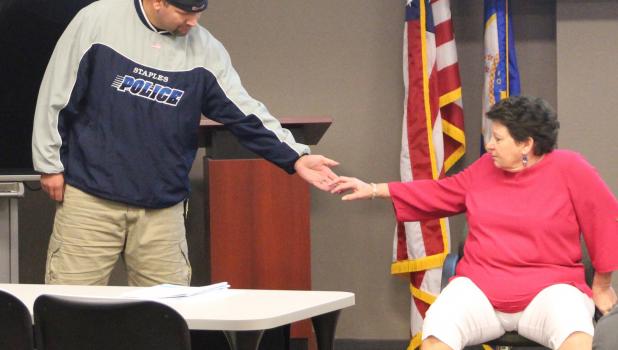
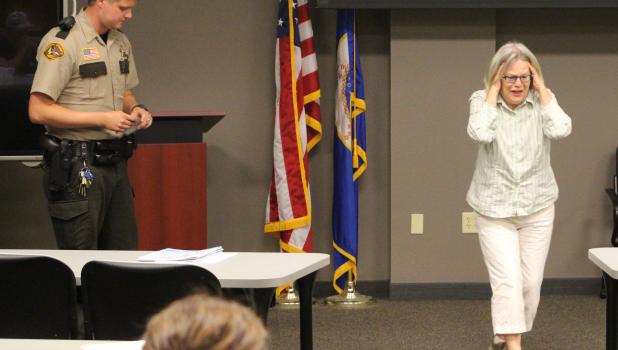
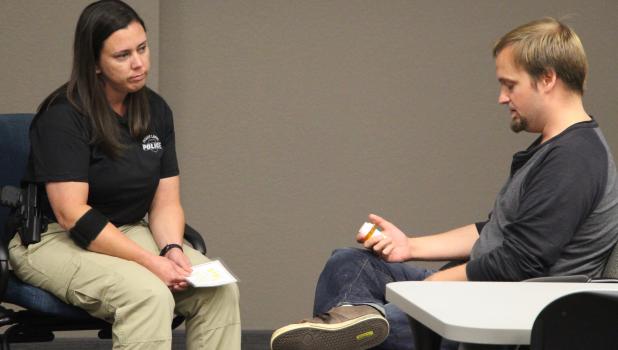
The unique part of this training is that actors are placed in situations where officers could practice what they were learning.
Mary DuBois of New York Mills and John Ryde-Crane of Duluth each played multiple roles during the four hour training, as did Flanders. “The officers are taking it all in, this is an excellent training because they are the first line of communication,” said DuBois.
The course covered the basic steps in dealing with distressed people including active listening skills, showing empathy, body language, building rapport, exerting influence and behavior change.
The day before the course, the actors learned the things needed so they could respond appropriately when the officers gave them the cues, good or bad.
“We have to take on all the characteristics of people with mental illness,” said DuBois.
Ryde-Crane said he really could feel the difference when the officer was calming or when they said something that wasn’t helpful. He found the roles challenging but, is hoping to do more acting in the near future.
The course, is typically 20 hours in length. Flanders said rural police departments usually can’t afford to send officers to the longer course, although she highly recommends it. She is willing to settle for a goal of getting all rural officers to at least know the basics of dealing with mental stress.
